
What to Do With a Stack of Business Cards After an Event


What to Do With a Stack of Business Cards After an Event
Somewhere in your bag is a rubber band around thirty business cards from last week's show. You have been meaning to deal with them since the flight home, and every day the pile gets a little harder to pick up, because dealing with it now means admitting you cannot remember which card belongs to which conversation.
Most of that stack is already dead. Not because the people were bad prospects, but because a card only ever held their identity, and the value was in the conversation attached to it. Memory of a specific conversation decays in days. The card does not know that Priya from Halewood Packaging wanted a quote before her October line upgrade. You knew that, briefly.
What is left can still be rescued, and the triage takes about fifteen minutes. Then it is worth fixing the process so there is never a next stack.
Sort into three piles before you type anything
Do not scan all thirty cards into your CRM. Do not build a spreadsheet. Sort first, because the piles get completely different treatment.
Pile one: you remember the conversation. The person, the problem they mentioned, maybe something you promised to send. These are live leads and they get a proper follow-up today or tomorrow. A 30-card stack usually yields five to ten of these, and they are the reason the whole exercise is worth doing.
Pile two: you remember the face but not the substance. You talked, it was pleasant, the details are gone. These get a LinkedIn connection request with an honest note: "Good to meet you at the Midlands Manufacturing Expo last week. Would be glad to stay connected." No fake specificity. You are not following up on a conversation you cannot recall, you are keeping a door open, and that is a fine outcome for pile two.
Pile three: nothing. No face, no context, just a name and a logo. Bin them. This feels wasteful, since someone handed you that card in good faith, but a card with no memory attached is a stranger's name. Loading it into your CRM does not make it a lead. It makes it clutter that inflates your contact count and pollutes every report built on top of it.
Write the pile-one follow-ups from memory, not from the card
The card gives you the email address. Everything that makes the message land comes from what you remember: the problem they raised, the timeline they mentioned, the thing you said you would send. One specific detail and a clear next step beats three paragraphs of company introduction. If you promised something, deliver it in the first message.
Speed matters more than polish here. A slightly rough email sent this week outperforms a perfect one sent next month, because the person you met had dozens of conversations too and their memory of you is decaying on the same curve as yours. There are copy-and-paste structures for hot, warm and nurture leads in our guide to following up after a conference.
Preventing the next stack
The stack exists because capture got deferred. The card went in a pocket as a promise to process it later, and later is where the context died.
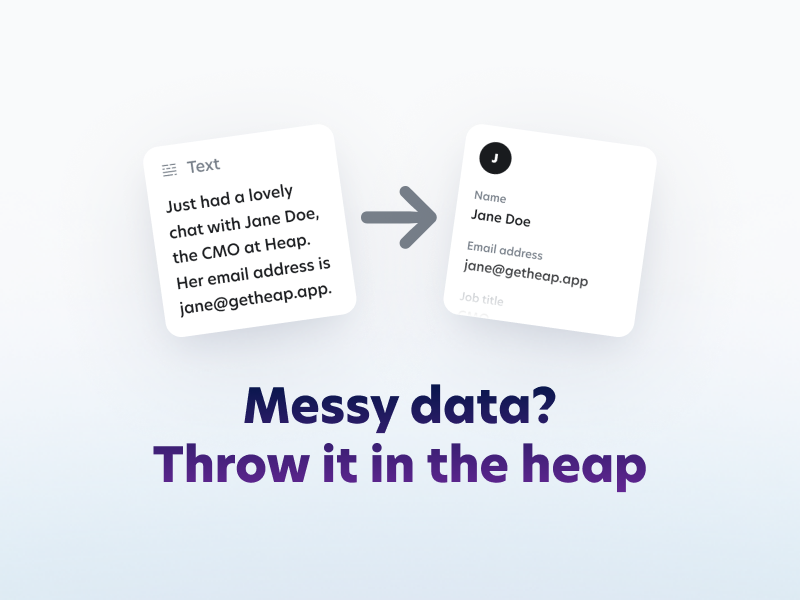
The fix is to capture at the moment of exchange, and it takes maybe twenty seconds longer than pocketing the card. Snap a photo of it, then add one sentence about the conversation while it is still in your head. With Heap, the photo fills in the name, company, title and email, and the sentence you add, "wants a quote before the October line upgrade, send the case study, seemed pressed for time", becomes the context on the lead. It can then find their LinkedIn so you connect on the spot, and draft the follow-up from your own words. The card carried identity. Your one sentence carried intent. Both are now somewhere better than a rubber band.
The honest part
No app can recover context you never captured. If the stack in front of you is ten days old, the three-pile triage is all there is, and pile three will be bigger than you would like. Tools change what happens at the next event. For this one, sort the piles, send the follow-ups, and forgive yourself for the bin.
Frequently asked questions
Should I add every business card to my CRM? No. Only contacts where you captured some context, or where there is a genuine reason to stay in touch. A CRM full of context-free names makes every pipeline report less trustworthy.
How quickly do business card contacts go cold? Treat a week as the outer limit for a real follow-up, and a day or two as the target. After that, memory has faded on both sides and your message reads like the mass send it probably is.
Is it rude to throw away someone's business card? The card did its job when it was handed over. What the person actually wanted was a useful follow-up, and no stack in a drawer has ever delivered one.
The bottom line
A stack of business cards is a to-do list disguised as an asset. Sort it into three piles tonight, follow up properly with the conversations you remember, connect politely with the faces you recognise, and bin the rest. Then change how you capture at the next event so the stack never forms again.


